Banking & Finance Corporate Law Land & Conveyance Mining Law IP Law Labour Law Family Law Litigation Social Security
WhatsApp Us Get In Touch
+255 782 449 777
saiattorneys@gmail.com

Legal Insights & Publications

Expert analysis of landmark Tanzanian court decisions, legal principles, and regulatory developments from our team of advocates.

P
Our Publications

Latest Legal Analysis

Our advocates regularly publish commentary on significant court decisions and legal developments affecting businesses and individuals in Tanzania.

Court of Appeal of Tanzania decision that an administrator of an estate should be sued in a representative capacity, Eliminata Masinda & Another v. Masweti Masinda & Another, Mashaka J.A., 26 February 2026 Succession Law
26 February 2026

Administrator of an Estate Should Not Be Sued in a Personal Capacity

Case Law Update. In Eliminata Masinda & Another v. Masweti Masinda & Another, the Court of Appeal held that an administrator must be cited in a representative capacity — suing them personally affects locus standi and can render the whole proceedings a nullity.

Locus Standi Estate Administration Probate
Read Analysis →
Court of Appeal of Tanzania decision on the validity of a Will altered by handwriting, Eliahu Lonyamali v. Mosses Lonyamali & Another, Sehel J.A., 10 February 2026 Probate
10 February 2026

When a Handwritten Alteration Casts Doubt on a Will

Legal Update. In Eliahu Lonyamali v. Mosses Lonyamali & Another, the Court of Appeal held a Will void where the last page had been altered by an unexplained handwritten insertion — casting doubt on the genuineness of the testamentary document.

Validity of Will Probate Succession
Read Analysis →
Court of Appeal of Tanzania decision on the duty of the first appellate court to re-evaluate evidence, Abdallah Yahaya Luhorela v. National Microfinance Bank PLC and Another Civil Procedure
4 February 2026

Re-evaluation of Evidence by the First Appellate Court

Legal Update. In Abdallah Yahaya Luhorela v. National Microfinance Bank PLC & Another, the Court of Appeal reaffirms the first appellate court’s duty to subject the entire evidence to a fresh and exhaustive re-assessment.

Appellate Review Evidence Civil Procedure
Read Analysis →
Court of Appeal of Tanzania decision on corporate personality and privity of contract, Wellworth Hotels & Lodges Ltd v. East Africa Canvas Co. Ltd Corporate Law
3 February 2026

Wellworth Hotels & Lodges Ltd v. East Africa Canvas Co. Ltd

Legal Update. The Court of Appeal reaffirms that a company is a distinct legal entity from its directors — who are not personally liable for the company’s obligations absent fraud, bad faith, or abuse of the corporate form.

Corporate Personality Corporate Veil Privity of Contract
Read Analysis →
Contract termination legal analysis Contract Law
15 June 2026

Unlawful Termination of Contract for Service

Analysis of PanAfrican Energy Tanzania Ltd v. Africa Geophysical Services Ltd — the Court of Appeal reaffirms that a contract cannot be lawfully terminated for non-performance before the agreed time has expired.

Contract Law Court of Appeal Commercial Law
Read Analysis →
Ex-parte judgment legal analysis Procedural Law
12 June 2026

Notice of the Date of Ex-Parte Judgment

In Tropical Air (Z) Ltd v. Godson Eliona Moshi, the Court of Appeal held that even where a case proceeds ex parte, the absent party must be notified of the judgment delivery date.

Civil Procedure Court of Appeal Ex-Parte
Read Analysis →
Court records legal analysis Judicial Integrity
12 June 2026

Sanctity of Court Records

In Evarist Arobogast v. R, the Court of Appeal emphasised that court records are the official and authoritative account of judicial proceedings and their integrity must be protected at all times.

Criminal Law Court of Appeal Judicial Integrity
Read Analysis →
Succession Law

Administrator of an Estate Should Not Be Sued in a Personal Capacity

26 February 2026 Case Law Update
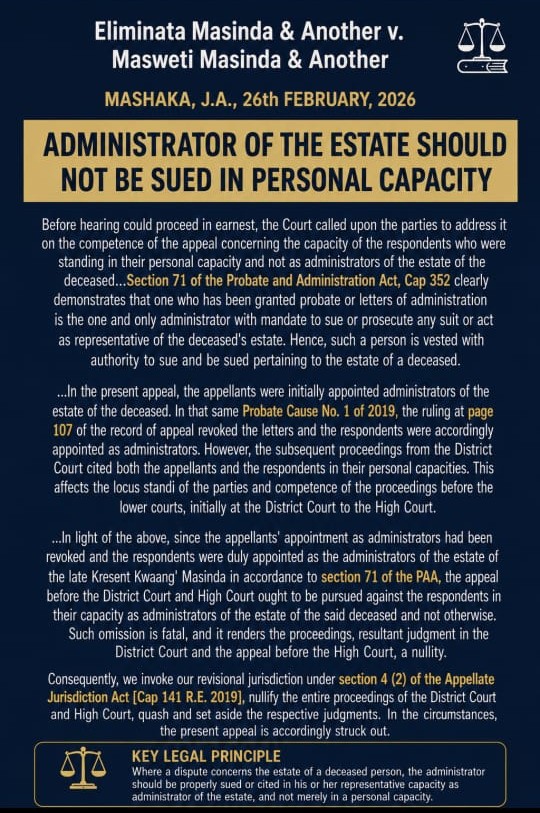
Case Law Update: Administrator of an Estate Should Not Be Sued in a Personal Capacity — Eliminata Masinda & Another v. Masweti Masinda & Another, Court of Appeal of Tanzania, Mashaka J.A., 26 February 2026

Case: Eliminata Masinda & Another v. Masweti Masinda & Another

Court: Court of Appeal of Tanzania

Coram: Mashaka, J.A.

Judgment Delivered: 26 February 2026

The Court of Appeal has reaffirmed an important principle concerning proceedings involving deceased persons’ estates. Under Section 71 of the Probate and Administration of Estates Act, Cap. 352, a person duly appointed as an administrator is the legal representative of the estate and is vested with authority to sue or be sued in relation to that estate.

In this case, the respondents had been duly appointed administrators of the deceased’s estate. However, the proceedings before the District Court cited both parties in their personal capacities rather than in their capacity as administrators of the estate.

The Court held that this was not a mere technicality. The improper citation affected the locus standi of the parties and the competence of the proceedings before the lower courts — an omission fatal to the entire matter.

Held

Invoking its revisional jurisdiction under section 4(2) of the Appellate Jurisdiction Act, Cap. 141 R.E. 2019, the Court nullified the entire proceedings of the District Court and the High Court, quashed and set aside the respective judgments, and struck out the appeal.

Key Legal Principle

Where a dispute concerns the estate of a deceased person, the administrator should be properly sued or cited in his or her representative capacity as administrator of the estate — not merely in a personal capacity. Proper identification of parties is not a matter of form; it can determine the competence and validity of the entire proceedings.

Succession Law

Letters of Administration in Tanzania: The Special Mirathi Account and Emerging Legal Challenges

Dr. Dimesh S. Mawji & Seleena Rahim Anand August 2026 Journal Article

Authors: Dr. Dimesh S. Mawji (PhD in Law) & Seleena Rahim Anand

Published in: African Journal of Emerging Issues (AJOEI) · Vol. 8, Issue 23, pp. 52–64 · Online ISSN: 2663-9335

Focus: Probate and Administration of Estates Act, Cap. 352 · Probate (Amendment) Rules, 2025 · Rule 105A — Special Mirathi Account

This article examines the legal framework governing Letters of Administration in Tanzania and the reforms introduced by the Probate (Amendment) Rules, 2025. Its most significant reform was the replacement of the court-controlled Judicial Mirathi Account with the Special Mirathi Account — a dedicated account, opened in the name of the estate and operated by the administrator under continuing judicial supervision pursuant to Rule 105A.

Letters of Administration are the legal authority granted by a court to administer the estate of a person who dies intestate. Under the reformed Rules, every administrator must, upon appointment, open a Special Mirathi Account, deposit all estate monies into it, file proof of every transfer together with the relevant bank statement, and make no withdrawals except by order of the court — measures designed to strengthen transparency, accountability and oversight of estate funds.

The article then identifies a critical legislative gap. While the law does not prohibit the appointment of a foreign national as an administrator, neither the Act nor the Rules prescribe how such an administrator is to satisfy the banking, Know-Your-Customer and anti-money-laundering (customer due diligence) requirements needed to open the mandatory account — particularly where the administrator is only temporarily present in Tanzania. The result is uncertainty, delay in collecting and preserving estate assets, and inconsistent practice among courts and financial institutions.

Proposed Reforms

• Amend the Probate (Amendment) Rules, 2025 to prescribe a clear account-opening procedure for foreign administrators — the documents required and the responsibilities of both the administrator and the financial institution.

• Issue Judicial Practice Directions to guide probate courts and promote consistency pending legislative amendment.

• Develop uniform Bank of Tanzania operational guidelines, reconciling succession law with banking regulation rather than exempting foreign administrators from it.

Key Takeaway

The 2025 Special Mirathi Account reform is a positive step towards accountability in estate administration — but a procedural gap leaves foreign administrators unable to reconcile the mandatory estate account with banking due-diligence rules. Closing that gap through targeted amendments, practice directions and uniform banking guidance would reduce delay and protect estates and beneficiaries.

Read Full Article →
Probate

When a Handwritten Alteration Casts Doubt on a Will

10 February 2026 Legal Update
Legal Update: When a Handwritten Alteration Casts Doubt on a Will — Eliahu Lonyamali v. Mosses Lonyamali & Another, Court of Appeal of Tanzania, Sehel J.A., 10 February 2026

Case: Eliahu Lonyamali v. Mosses Lonyamali & Another

Court: Court of Appeal of Tanzania

Coram: Sehel, J.A.

Judgment Delivered: 10 February 2026

A Will is more than a document. It is the legal expression of a person’s final wishes, and its authenticity and integrity are therefore fundamental.

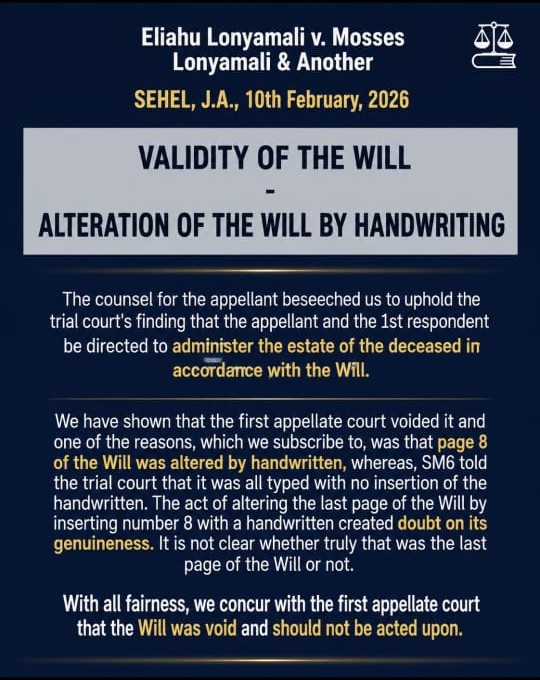
In this case, the Court of Appeal considered a Will in which the last page had been altered by a handwritten insertion of the number “8”. The alteration was significant because the evidence indicated that the Will was otherwise entirely typed, with no explanation offered for the handwritten insertion.

The Court observed that the alteration created doubt as to whether the disputed page was genuinely part of the original Will. Where the authenticity of the document itself is uncertain, the Will cannot safely be relied upon.

Held

Concurring with the first appellate court, the Court of Appeal held that the Will was void and could not be acted upon. The act of altering the last page by inserting a handwritten number created doubt on its genuineness, and it was not clear whether that was truly the last page of the Will.

Legal Lesson

An unexplained alteration to a Will can go beyond a mere clerical issue — it may undermine the genuineness of the entire testamentary document. When drafting a Will, proper execution, consistency, preservation, and careful handling of the original document are essential. Know the law. Protect the legacy.

Civil Procedure

Re-evaluation of Evidence by the First Appellate Court

4 February 2026 Legal Update
Legal Update: Re-evaluation of Evidence by the First Appellate Court — Abdallah Yahaya Luhorela v. National Microfinance Bank PLC & Another, Masoud J.A., 4 February 2026

Case: Abdallah Yahaya Luhorela v. National Microfinance Bank PLC & Another

Coram: Masoud, J.A.

Judgment Delivered: 4 February 2026

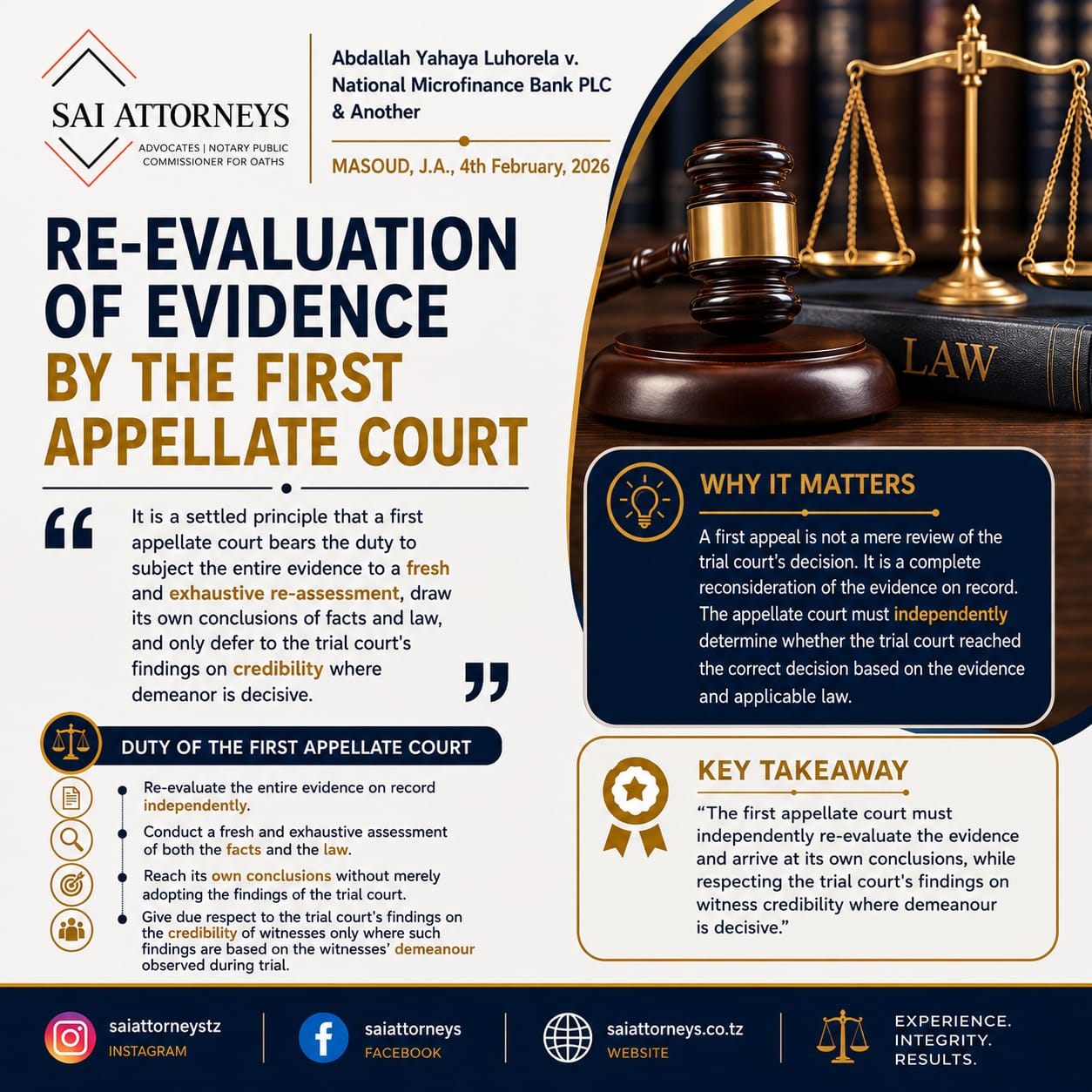
It is a settled principle that a first appellate court bears the duty to subject the entire evidence to a fresh and exhaustive re-assessment, draw its own conclusions of facts and law, and only defer to the trial court’s findings on credibility where demeanour is decisive.

A first appeal is not a mere review of the trial court’s decision. It is a complete reconsideration of the evidence on record. The appellate court must independently determine whether the trial court reached the correct decision based on the evidence and applicable law.

Duty of the First Appellate Court

• Re-evaluate the entire evidence on record independently.

• Conduct a fresh and exhaustive assessment of both the facts and the law.

• Reach its own conclusions without merely adopting the findings of the trial court.

• Give due respect to the trial court’s findings on the credibility of witnesses only where such findings are based on the witnesses’ demeanour observed during trial.

Key Takeaway

The first appellate court must independently re-evaluate the evidence and arrive at its own conclusions, while respecting the trial court’s findings on witness credibility where demeanour is decisive.

Intellectual Property

The Missing Timeline: Trademark Registration and Administrative Delays in Tanzania

Dr. Dimesh S. Mawji & Seleena Rahim Anand May–June 2026 Journal Article

Authors: Dr. Dimesh S. Mawji (PhD in Law) & Seleena Rahim Anand

Focus: Trade and Service Marks Act, 1986 · BRELA · Online Registration System (ORS)

This article examines the legal and institutional framework governing trademark registration in Tanzania. It analyses the role of trademarks in protecting commercial identity under the Trade and Service Marks Act of 1986 and the Trade and Service Marks Regulations of 2002, as administered by the Business Registration and Licensing Agency (BRELA).

Tracing the registration process from the filing of an application to the issuance of a certificate, it identifies a significant gap in the existing framework: the absence of statutory timelines governing the performance of the Registrar’s functions. That gap grants broad administrative discretion to the Registrar, resulting in delays, uncertainty, and inefficiency in trademark administration.

While the introduction of the Online Registration System (ORS) has improved accessibility and convenience for applicants, it has not addressed the underlying legislative gap relating to the timely discharge of the Registrar’s duties. The article contends that such delays undermine the effective protection of proprietary rights, expose businesses to infringement and unfair competition, and weaken commercial certainty.

Key Takeaway

Legislative reform is necessary to introduce enforceable timelines, enhance administrative efficiency, and strengthen accountability within Tanzania’s trademark registration system — giving businesses the certainty and protection they need.

Read Full Article →
Corporate Law

Wellworth Hotels & Lodges Ltd v. East Africa Canvas Co. Ltd

3 February 2026 Legal Update
Legal Update summary: Wellworth Hotels & Lodges Ltd v. East Africa Canvas Co. Ltd, Court of Appeal of Tanzania, decided 3 February 2026

Court: Court of Appeal of Tanzania

Judge: Fikirini, J.A.

Decision: 3 February 2026

At the heart of the decision: Corporate Personality · Corporate Veil · Privity of Contract

The Court of Appeal has reaffirmed that a company is a distinct legal entity from its directors. As a general rule, directors acting within the scope of their authority are not personally liable for the company’s contractual obligations.

The Court further observed that liability cannot be imposed on directors merely because they acted on behalf of the company. In the absence of fraud, bad faith, or other exceptional circumstances warranting the lifting of the corporate veil, responsibility remains with the company.

This decision also reinforces the doctrine of privity of contract, confirming that only parties to a contract may enforce or be held liable under its terms.

Facts

The appellant alleged that the 2nd and 3rd respondents, as directors of the 1st respondent company, induced the breach of contract and should be held personally liable. The trial court found no evidence to support the claim and held that the directors acted within the scope of their corporate duties.

Held

The Court of Appeal affirmed that directors are not personally liable for acts performed in the ordinary course of managing the company. Personal liability can only arise where it is shown that the directors acted outside their authority, fraudulently, or in bad faith.

Key Legal Principle

A company is a distinct legal entity, separate from its directors. Only parties to a contract are bound by it and may sue or be sued thereunder. The corporate veil will only be lifted in exceptional circumstances involving wrongdoing, fraud, or abuse of the corporate form.

Land Law

Athumani Rubindo v. Zuhura Fredriki Kalo & 2 Others

13 May 2026 Case of the Week
Case of the Week summary: Athumani Rubindo v. Zuhura Fredriki Kalo & 2 Others, Court of Appeal of Tanzania at Mwanza, Civil Appeal No. 17 of 2024

Court: Court of Appeal of Tanzania at Mwanza

Civil Appeal No.: 17 of 2024

Coram: Mwandambo, Kente & Mgonya, JJA

Judgment Delivered: 13 May 2026

Jurisdiction is the foundation of every legal proceeding. A court cannot assume jurisdiction merely because it has unlimited powers. Where the law requires a suit to be filed in the court of the lowest competent grade, failure to do so renders the proceedings a nullity.

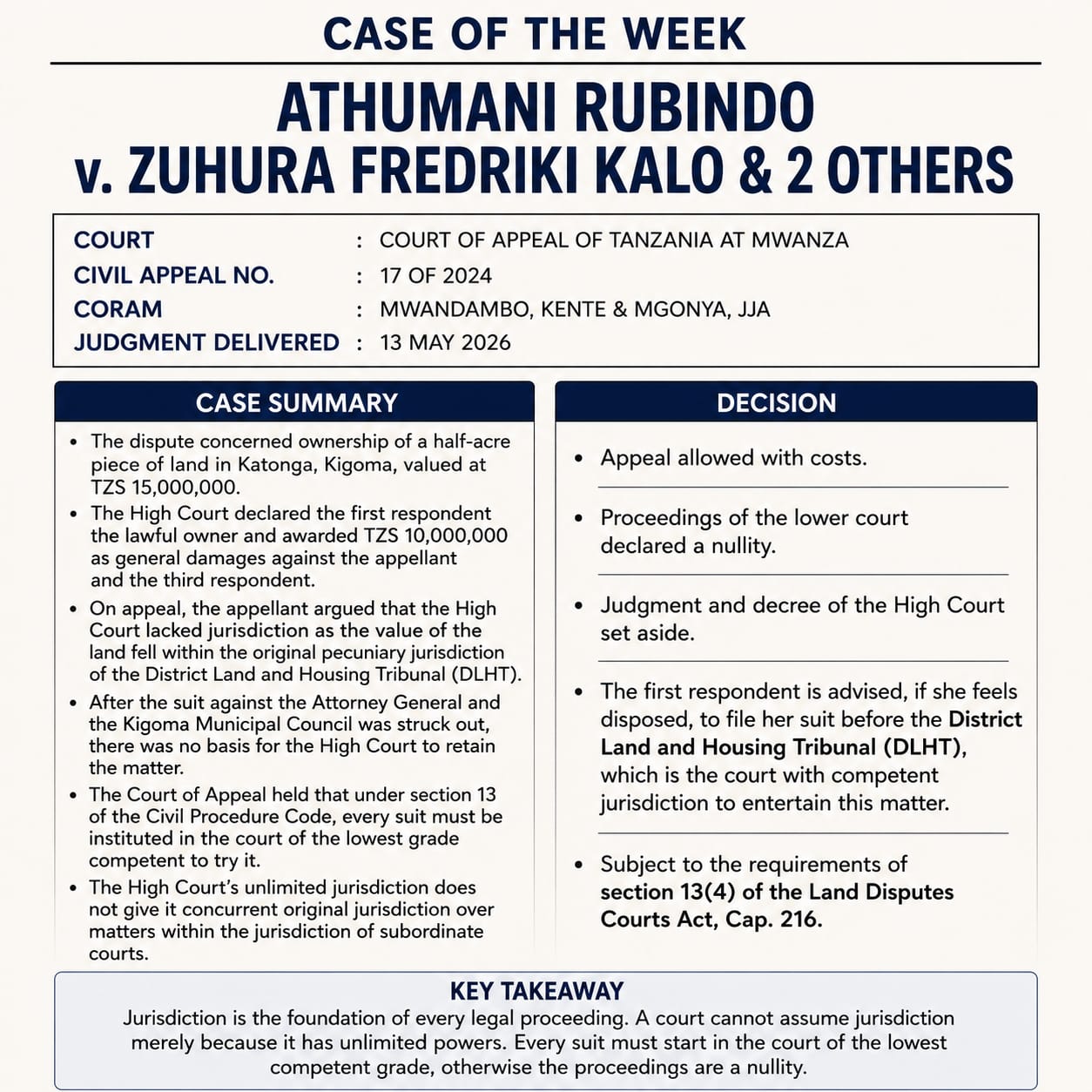
The dispute concerned ownership of a half-acre piece of land in Katonga, Kigoma, valued at TZS 15,000,000. The High Court declared the first respondent the lawful owner and awarded TZS 10,000,000 as general damages against the appellant and the third respondent.

On appeal, the appellant argued that the High Court lacked jurisdiction, as the value of the land fell within the original pecuniary jurisdiction of the District Land and Housing Tribunal (DLHT). After the suit against the Attorney General and the Kigoma Municipal Council was struck out, there was no basis for the High Court to retain the matter.

The Court of Appeal held that under section 13 of the Civil Procedure Code, every suit must be instituted in the court of the lowest grade competent to try it. The High Court’s unlimited jurisdiction does not give it concurrent original jurisdiction over matters falling within the jurisdiction of subordinate courts.

The Decision

• Appeal allowed with costs.

• Proceedings of the lower court declared a nullity; judgment and decree of the High Court set aside.

• The first respondent is advised, if she feels disposed, to file her suit before the District Land and Housing Tribunal (DLHT), the court with competent jurisdiction — subject to the requirements of section 13(4) of the Land Disputes Courts Act, Cap. 216.

Key Takeaway

Jurisdiction is the foundation of every legal proceeding. A court cannot assume jurisdiction merely because it has unlimited powers. Every suit must start in the court of the lowest competent grade, otherwise the proceedings are a nullity.

Intellectual Property

An Analysis of Legal, Institutional and Practical Challenges During Registration of Trademarks in Mainland Tanzania

Dr. Dimesh S. Mawji 2025 PhD Thesis

Author: Dr. Dimesh S. Mawji

Focus: Trade and Service Marks Act, 1986 · BRELA · Madrid Protocol & ARIPO

This doctoral study examines the legal, institutional, and practical challenges during trademark registration in Mainland Tanzania, with a particular focus on administrative inefficiency and the absence of effective control mechanisms in the existing trademark legislation.

Employing a mixed methodology that combines doctrinal, empirical, and benchmark analysis, it draws on primary data from legislation and secondary data from interviews with key stakeholders — including legal practitioners, trademark owners, and officials from the Business Registration and Licensing Agency (BRELA). The findings reveal significant gaps within the legislative framework and administrative processes, underscoring the need for urgent reform.

The analysis shows that the Trade and Service Marks Act of 1986, inherited from colonial-era laws, grants the Registrar broad powers without establishing specific timeframes for essential administrative actions such as examination, advertisement, and registration. This lack of regulatory oversight has resulted in prolonged delays, which disadvantage service seekers, hinder business innovation, and create opportunities for corrupt practices. The study further explores the incompatibility of Tanzania’s trademark regime with international frameworks such as the Madrid Agreement and its Protocol, as well as the regional system under the African Regional Intellectual Property Organisation (ARIPO).

Key Takeaway

Introducing time-bound administrative provisions, establishing legal or judicial remedies for undue delays, and harmonising national law with international and regional standards would enhance the efficiency, transparency, and competitiveness of Tanzania’s trademark system — benefitting both the business community and the national economy.

Read Full Article →
Intellectual Property

Filing Regional Trademarks in Tanzania: Key Legal Challenges

Dr. Dimesh S. Mawji September–October 2025 8 min read

Author: Dr. Dimesh S. Mawji

Published in: International Journal for Multidisciplinary Research (IJFMR)

Citation: Volume 7, Issue 5, September–October 2025 · E-ISSN: 2582-2160

Focus: ARIPO Banjul Protocol & Tanzania’s trademark regime

This article critically examines the legal challenges of filing regional trademark applications in Tanzania under the framework of the African Regional Intellectual Property Organization (ARIPO). While Tanzania acceded to the Banjul Protocol in 1999, the Trade and Service Marks Act, 1986 has never been amended to domesticate its provisions — leaving a significant gap between Tanzania’s regional commitments and its domestic law.

Trademarks are vital instruments for market regulation and economic efficiency. They protect consumers from confusion and safeguard the goodwill businesses build in their brands. The full benefits of trademark protection, however, depend on timely and proper registration. The Banjul Protocol offers a centralised filing procedure administered by ARIPO, allowing applicants to designate multiple member states through a single application — reducing the cost and complexity of securing protection across Africa.

The article addresses three central questions: the extent to which Tanzanian law accommodates regional filings under the Banjul Protocol; the legal, economic, and governance impacts of non-domestication; and the reforms necessary to align Tanzania’s trademark regime with regional integration goals.

A comparative review shows that ARIPO members such as Zimbabwe, Botswana and Kenya have amended their national laws to give effect to ARIPO registrations. By contrast, Tanzania’s failure to domesticate the Protocol leaves trademark protection fragmented and costly, disproportionately excludes small and medium enterprises from affordable cross-border protection, exposes Tanzanian brands to misappropriation in regional markets, and undermines investor confidence — while also sitting uneasily with the country’s obligations under the EAC and the AfCFTA.

Key Takeaway

Amending the Trade and Service Marks Act, 1986 to give domestic effect to the Banjul Protocol is not merely a technical adjustment, but a necessary step towards strengthening Tanzania’s competitiveness in regional and continental markets — ensuring ARIPO registrations designating Tanzania acquire direct legal effect, lowering costs, and safeguarding Tanzanian brands across Africa.

Read Full Article →
Contract Law

Unlawful Termination of Contract for Service

15 June 2026 5 min read

Case: PanAfrican Energy Tanzania Ltd v. Africa Geophysical Services Ltd

Court: Court of Appeal of Tanzania

Judge: Mwampashi, J.A.

Date: 3rd February 2026

In this landmark decision, the Court of Appeal reaffirmed an important principle of contract law: a contract cannot be lawfully terminated for non-performance before the agreed time for performance has expired.

The Court found that when the termination notice was issued and even when the contract was terminated, the respondent still had time remaining under the contract to complete the work. Therefore, the appellant had no valid justification for terminating the contract.

At the time of the issuance of the notice for termination of the Contract by the appellant and even at the time when the Contract was terminated, the period of time for the completion of the Contract was still on the respondent's side. The time for the performance and completion of the work under the Contract had not lapsed.

The 5th ground of appeal was thus dismissed. For the above given reasons and also for the reasons given by the High Court, the appellant had no good reasons justifying the termination of the Contract. The High Court finding and holding that the termination of the Contract was unlawful cannot be faulted.

Key Takeaway

A party cannot allege breach or terminate a contract merely because performance has not yet been completed where the contractual period for performance has not lapsed. Premature termination may itself constitute a breach of contract and attract liability for damages.

Procedural Law

Notice of the Date of Ex-Parte Judgment

12 June 2026 6 min read

Case: Tropical Air (Z) Ltd v. Godson Eliona Moshi

Court: Court of Appeal of Tanzania

Judge: Mkuye, J.A.

Date: 4th March 2025

In this significant ruling, the Court of Appeal emphasised that even where a case proceeds ex parte, the absent party must be notified of the date fixed for delivery of judgment.

Order XX Rule 1 of the Civil Procedure Code requires parties to be informed of the judgment date when judgment is not delivered immediately after the hearing. This provision is couched in mandatory terms for the notification to the parties in the proceedings if the judgment is not delivered at once after the case has been heard.

The appellant was not in attendance when the matter proceeded ex-parte and there was no proof that he was served with a copy of notice of delivery of the ex-parte judgment. However, according to the above cited authority, the appellant ought to have been notified regardless of whether he had no right of audience.

Failure to notify a party of the delivery date is a serious procedural irregularity that may prejudice that party's right to challenge the decision in time. The Court held that a party who did not participate in the hearing still has a right to know the final outcome of the case.

Key Takeaway

An ex-parte hearing does not remove the court's obligation to notify parties of the judgment date. Procedural fairness must be maintained at all times. Where such notice is not given, the proceedings and judgment may be set aside and the matter ordered to be heard afresh.

Judicial Integrity

Sanctity of Court Records

12 June 2026 5 min read

Case: Evarist Arobogast v. R

Court: Court of Appeal of Tanzania

Judge: Kitusi, J.A.

Date: 10th May 2024

In this important decision, the Court of Appeal emphasised that court records are the official and authoritative account of judicial proceedings. Their integrity must be protected at all times because public trust in the administration of justice depends on the accuracy and reliability of those records.

The principle of the sanctity of court records means that court proceedings, evidence, rulings, and judgments must be recorded, preserved, and treated with utmost care. Any alteration, misrepresentation, or compromise of court records undermines the credibility of the justice system and may lead to serious miscarriages of justice.

As the Court observed, maintaining the integrity of court records is essential to safeguarding fairness, transparency, accountability, and public confidence in the judiciary.

Key Takeaway

"Justice must not only be done but must also be seen to be done, and trustworthy court records are fundamental to achieving that objective." The sanctity of court records must never be compromised to maintain people's confidence in our justice system.

Need Legal Guidance?

Our team of experienced advocates is ready to provide expert counsel on your legal matters. Get in touch today for a confidential consultation.