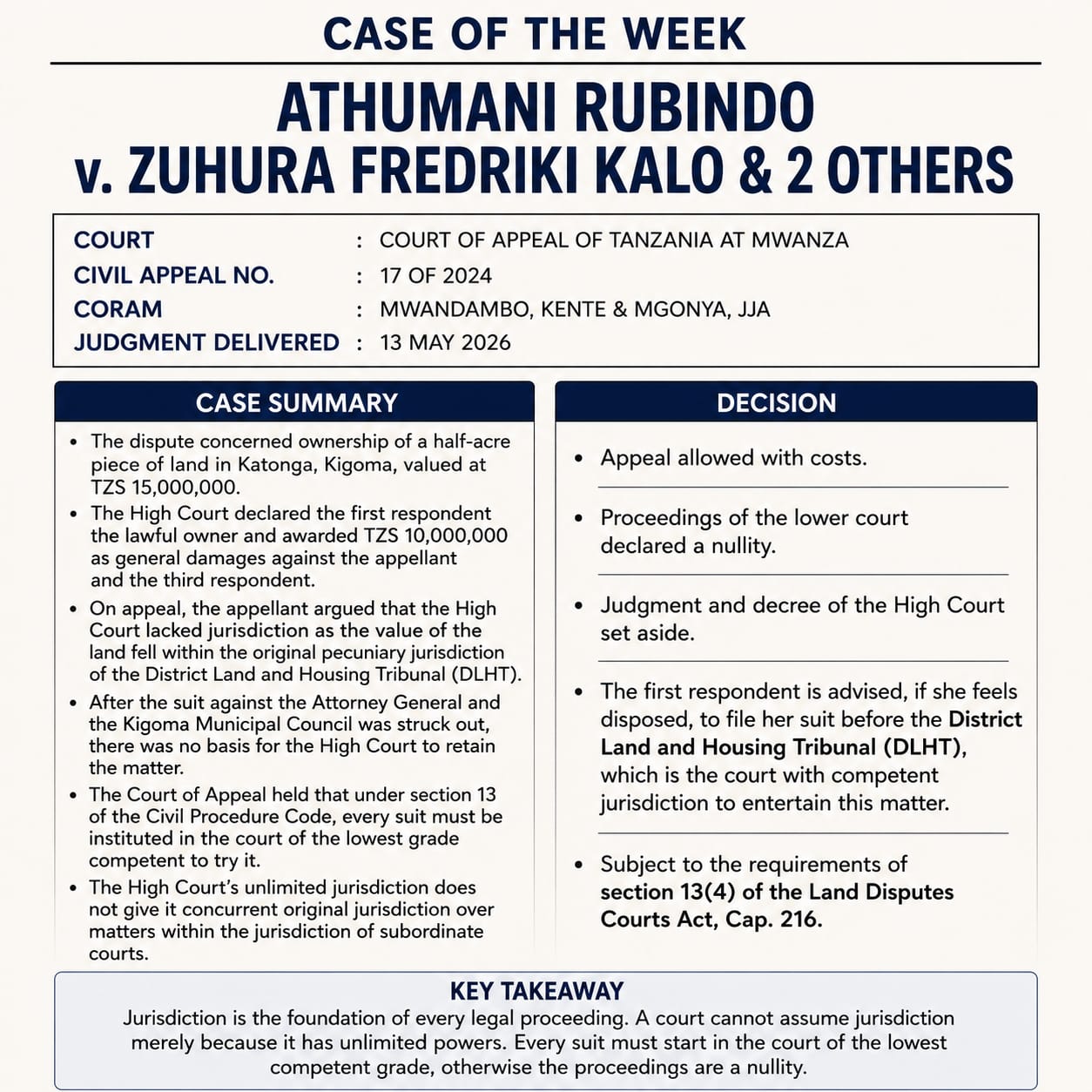
Court: Court of Appeal of Tanzania at Mwanza
Civil Appeal No.: 17 of 2024
Coram: Mwandambo, Kente & Mgonya, JJA
Judgment Delivered: 13 May 2026
Jurisdiction is the foundation of every legal proceeding. A court cannot assume jurisdiction merely because it has unlimited powers. Where the law requires a suit to be filed in the court of the lowest competent grade, failure to do so renders the proceedings a nullity.
The dispute concerned ownership of a half-acre piece of land in Katonga, Kigoma, valued at TZS 15,000,000. The High Court declared the first respondent the lawful owner and awarded TZS 10,000,000 as general damages against the appellant and the third respondent.
On appeal, the appellant argued that the High Court lacked jurisdiction, as the value of the land fell within the original pecuniary jurisdiction of the District Land and Housing Tribunal (DLHT). After the suit against the Attorney General and the Kigoma Municipal Council was struck out, there was no basis for the High Court to retain the matter.
The Court of Appeal held that under section 13 of the Civil Procedure Code, every suit must be instituted in the court of the lowest grade competent to try it. The High Court’s unlimited jurisdiction does not give it concurrent original jurisdiction over matters falling within the jurisdiction of subordinate courts.
The Decision
• Appeal allowed with costs.
• Proceedings of the lower court declared a nullity; judgment and decree of the High Court set aside.
• The first respondent is advised, if she feels disposed, to file her suit before the District Land and Housing Tribunal (DLHT), the court with competent jurisdiction — subject to the requirements of section 13(4) of the Land Disputes Courts Act, Cap. 216.
Key Takeaway
Jurisdiction is the foundation of every legal proceeding. A court cannot assume jurisdiction merely because it has unlimited powers. Every suit must start in the court of the lowest competent grade, otherwise the proceedings are a nullity.

 Legal Ethics